

Europe just signed a monumental trade deal with the US — why is this not the slam dunk that it seems for the US?
Like Japan, Europe just agreed to a 15% across-the-board tariff, while the US will enjoy no tariffs on its exports to EU. Europe promised additional investments in the US, along with energy and weapons purchases. Europeans are ”appalled” at this deal, which looks like total surrender to Trump. Meanwhile, MAGAfans like Rod Martin view this deal as a huge victory. On the surface, Rod’s rod for Donald is justified. Trump got big concessions and made very few. But when you dig deeper, this is neither the surrender for Europe nor the win for domestic manufacturing we’ve been sold.
The one indisputable benefit of this deal is the end to trade war chaos. Even a punitive certainty is better than hopeful ambiguity, which made long-term planning impossible. Both Europe and US win in this regard.
The revenue from new tariffs is a double-edged sword, depending on who pays. Luxury brands are thrilled. They can absorb or pass on the extra cost because of high margins and price insensitive customers. Sellers of highly differentiated foreign goods that have few substitutes, will also pass higher costs to US consumers. Only producers of commodities (or categories with lots of substitutes, like mid-tier cars) will have to eat some of the tariffs. Ironically, the billions in new taxes are desperately needed to close the gaping budget deficits created by the “One Big Beautiful Bill”. Republican Josh Hawley is even proposing a $600 tariff rebate to Americans as reparations.
As Howard Lutnick admits, many details of this deal aren’t hammered out yet. Two of these seem far-fetched.
The WSJ and economic analysts think Europe’s $750B commitment to buy US energy is a fantasy. Europe bought $16-19B in all of 2024 and that much in the first half of 2025. At that level, our production and shipping capacity, along with Europe’s buying capacity, are maxed out. Hitting $250B a year would require the (return of the?) Messiah.
The other suspicious figure is a promise by Europe to invest $600B in the US. This follows a long string of similar announcements by Saudi Arabia, Qatar, Japan, and Narnia. No details, no timeline, no penalties for non-performance. Just a big crazy number to puff up Trump’s ego at a press conference. They’ve all cracked the super-secret code to our stoic, mysterious leader’s heart (and toilets) of gold. He likes big bucks and he cannot lie. (He can.) Let’s put it this way, don’t add these numbers to your 401k calculator just yet.
The most interesting commitment is “hundreds of billions” in military purchases. Not only does it address one of Trump’s biggest gripes with NATO members not paying their fair share (even war needs a Bernie Sanders), but it binds America’s military industrial complex to European defense. We are now inseparable in the only way America understands—money. As a byproduct, it also stunts any domestic manufacturing Europe may have been planning. No self-reliance on the horizon. (Writer Warwick Powell thinks this was an intentional move by Europe. I think it’s more incidental and expedient.)
When it comes to spurring manufacturing, it’s a mixed bag. We clearly beefed up our defense industry, which didn’t need the help. Beyond that, I doubt 15% is a big enough number to incentivize a big push for domestic manufacturing. In fact, 15% is a lower tariff on cars than what existed. It might even motivate BMW and Mercedes, which have been producing in the US, to re-shore that production. A lot will depend on the strength of the dollar, which has dropped 10% since the start of the year, and other conditions (taxes, incentives, labor cost/supply) that can make manufacturing in the US more or less attractive.
A lot of what I expect to happen is business-as-usual, because of loose enforcement and vague commitments. Even the exemptions for chemicals, agriculture, and aircraft are nods to worries about key inputs, inflation, and powerful lobbies.
Consistent with my series on manufacturing, this victory is shortsighted. This exchange on X captures my feelings on this weak use of American leverage.
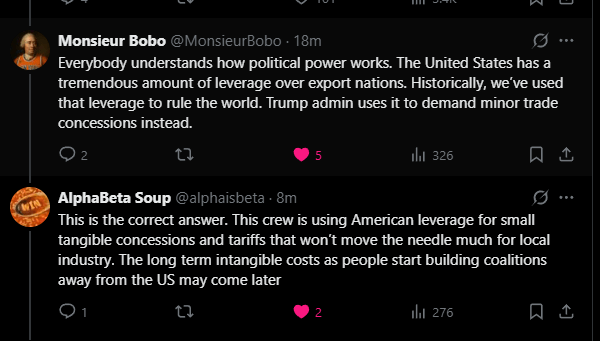
By treating European allies no different than China—as adversaries and customers—we get concessions today and trade re-routed around the US, tomorrow. Transactional relationships are reciprocated, in kind. NATO was supposed to be a true allyship. Now, it’s an ex-girlfriend that still shares custody of the chihuahua.
Or maybe nothing consequential actually happens, besides a big tax hike on American consumers.


